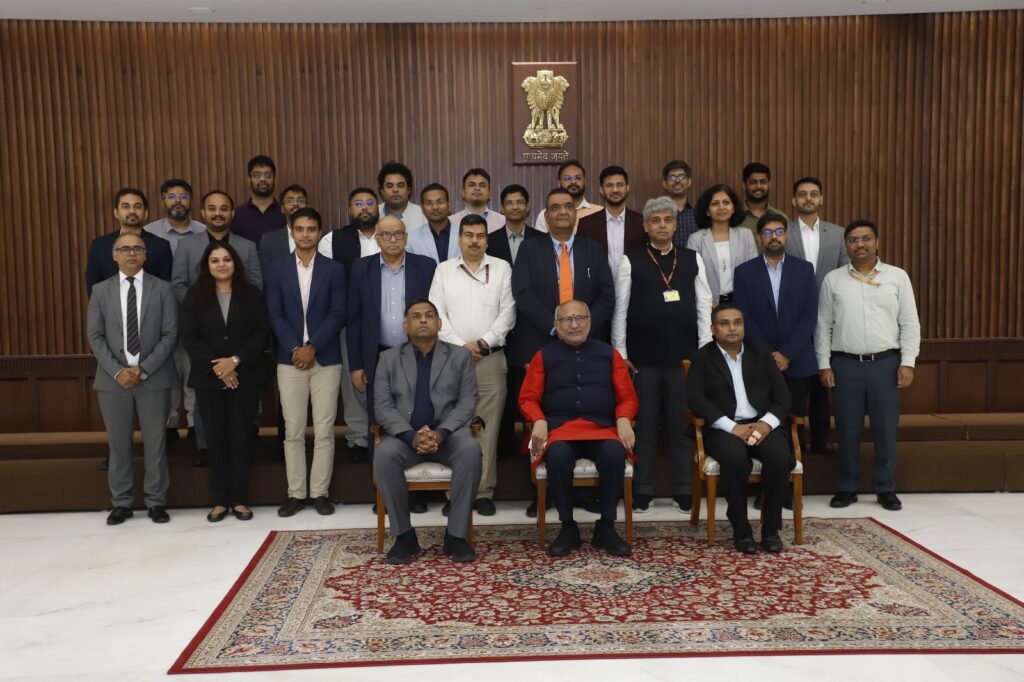
Shri C. P. Radhakrishnan, the Honourable Vice President of India, today unveiled Gnani Artha, an end-to-end sovereign AI stack for Indian enterprises and public institutions. Gnani Artha is built on two key components: Gnani Evon v3.3 – a 30-billion-parameter open-weights model trained natively across 11 Indian languages – and Gnani Plexus, the company’s agentic AI platform.
Speaking on the occasion, the Hon’ble Vice-President of India said, “Bharat is making significant strides in AI. India’s approach focuses on making AI open, affordable, and accessible, ensuring that innovation uplifts society as a whole. I congratulate Gnani AI on this significant milestone and I am pleased to launch Gnani Artha, which brings together the power of Evon, a large language model, and Plexus, a platform that connects this intelligence with real-world work and institutions. Both these platforms reflect the growing strength of India’s technology ecosystem. This initiative shows that our engineers have the capability not only to use frontier technologies, but also to build them. May this initiative continue to building a stronger, more self-reliant, and technologically empowered India.”
Consider a loan file that arrives at an Indian lender’s office: an application form filled in Marathi, six months of bank statements, GST filings, and photographs of multiple identity documents.
Reading it takes judgement, not transcription: cross-checking declared income against actual turnover and finding the inconsistencies that matter. Every lender in India handles thousands of these a day. Almost none can do it with AI that reasons well enough in the applicant’s own language, at a cost that is sustainable at that scale, and without the file ever leaving the lender’s own systems.
Handling that file takes three things at the same time: intelligence that reasons in the applicant’s own language, economics that survive thousands of files a day, and a way to put both into production inside the lender’s own systems. Indian institutions have had these in fragments. Gnani Artha brings them together as one stack.
GNANI EVON V3.3 – SOVEREIGN LLM THAT CUTS THE LANGUAGE TAX ON INDIAN AI
Evon v3.3 is a 30-billion-parameter model with roughly 3.5 billion parameters active on any given token. On MILU, a widely used Indian-language benchmark spanning eleven languages and dozens of academic and professional subjects, Evon v3.3 outperforms a 105-billion-parameter Indic model on ten of eleven languages and a similarly sized 30B model on all eleven – and achieves parity with a similar-size, hosted global frontier model.
Because Evon v3.3 ships as open weights that run on a single node, it can be deployed entirely inside an institution’s own data centre or virtual private cloud. This lets banks, insurers and government bodies meet DPDP, RBI and IRDAI residency requirements without customer data ever leaving their own infrastructure.
To make the economics work, Gnani AI rebuilt the model’s tokenizer – the layer that breaks language into the units a model processes – for Indian scripts. Evon v3.3 needs roughly 20% fewer tokens per Indian-language word than the tokenizer used by the GPT-5 family, and less than half of what byte-level tokenizers such as DeepSeek, Llama and Qwen require. Fewer tokens mean lower compute cost, faster responses, and more usable context per query.
GNANI PLEXUS – TURNING SOVEREIGN INTELLIGENCE INTO REAL-WORLD IMPACT
Plexus is Gnani AI’s agentic AI platform. Each agent is a discrete, identity-bearing unit – closer to an employee than a script – combined with other agents into workflows built around a defined outcome.
For example, in grievance resolution by government agencies, a multilingual AI agent captures a citizen’s complaint. A reasoning agent then detects patterns across recent complaints – a spike in one district, one recurring failure – files a single consolidated ticket with the department that owns it, and closes the loop with the citizen once it is resolved.
In bank reconciliation, an AI agent matches millions of line items across bank statements, core-banking ledgers and payment-switch logs. It clears the clean matches, drafts a root-cause narrative for each genuine exception, and routes it to the team that owns it – automating one of the highest-cost manual functions in Indian banking.
These workflows run under an orchestration layer that can be human-in-the-loop or AI-led, with guardrails, observability and audit logging built in rather than added afterwards. Plexus integrates with enterprise and public digital infrastructure, supports tool calling and a choice of underlying models including Gnani Evon v3.3, and works across documents, systems and conversations alike.
“Sovereign AI is not about keeping the world out. It is about India having the capability to build for itself – and then for every country that shares its problems, “concluded Gopalan.
Evon v3.3. weights are available by request on Hugging Face under an Apache 2.0 licence. Plexus becomes available to enterprise customers.